Most warehouses, retail units and industrial sheds around Bromley sit under a flat or low-pitch roof, and increasingly that roof is single-ply membrane. It’s become the default choice for large commercial spans, and for good reason. Here’s what it actually is and why it works so well at scale. Since you might be specifying it for a new build or a re-cover, here’s what to expect too.
What single-ply membrane roofing is
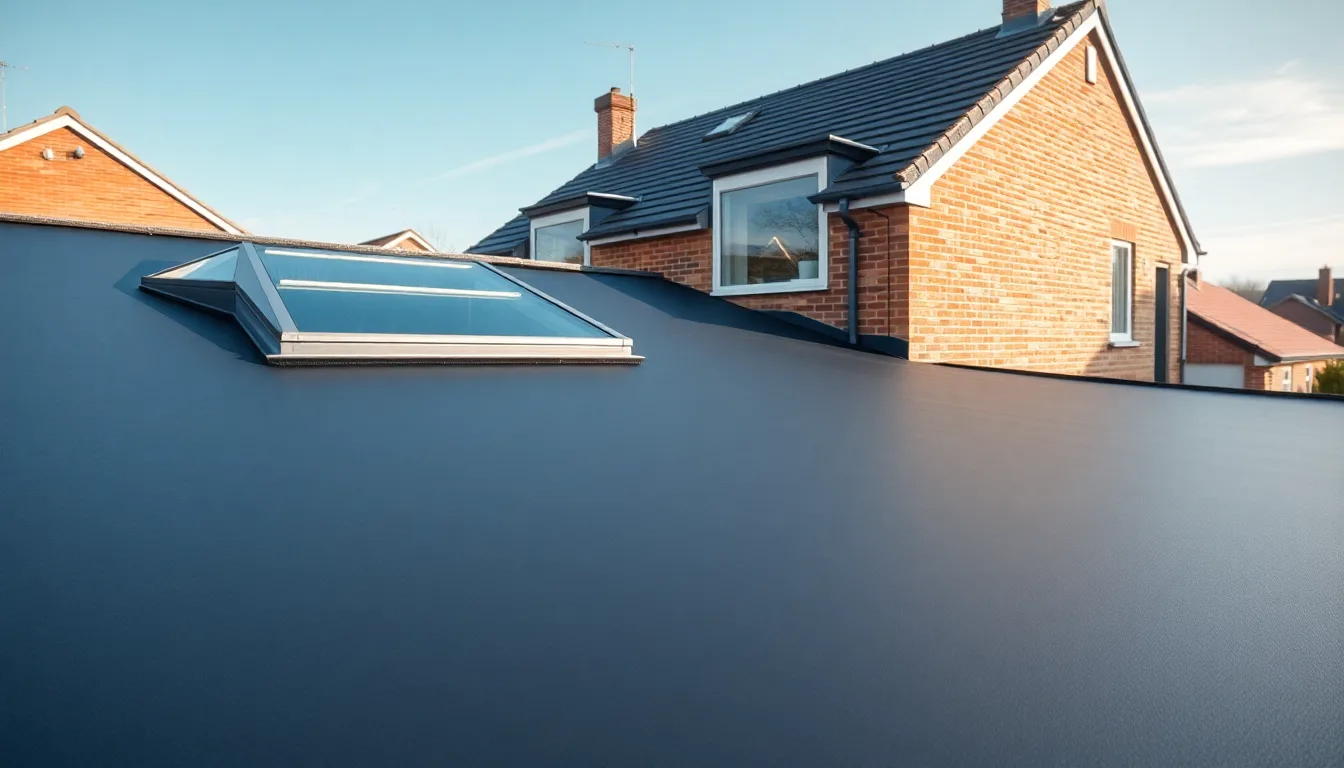
Single-ply membrane is exactly what it sounds like: one continuous layer of flexible material, rolled out and fixed across the whole roof deck. In contrast, it replaces the multiple layers you’d get with built-up felt systems. The sheets are welded together at the joints, giving one unbroken waterproof surface with far fewer weak points than a layered system.
It’s mechanically fixed, fully adhered, or ballasted depending on the building and the wind loading involved. Large commercial roofs almost always use mechanical fixing or full adhesion. Ballasted systems need more structural capacity than most industrial decks can offer.
Why it suits commercial and industrial buildings
Scale is the main reason. A single-ply roof can cover thousands of square metres with far fewer seams than felt or GRP. Fewer seams means fewer places for water to find a way in. Since access for repairs is difficult and costly on a large industrial roof, that matters enormously.
Weight is another factor. Single-ply is light compared with built-up felt or a green roof system. As a result, loading stays low on steel-framed sheds that weren’t designed to carry much extra. It’s also fast to install across a big area, which matters when a business can’t afford weeks of disruption.
We fit single-ply as part of our Flat Roofing service for exactly this reason — it’s the system that makes sense for most large flat commercial roofs we’re asked to cover.
The main types of single-ply membrane
Three materials dominate the UK commercial market: PVC, TPO and EPDM. PVC is the most common for new-build commercial work — it’s flexible, hot-air welds cleanly, and handles rooftop plant and foot traffic well. While TPO is a newer alternative, it’s gained ground for its lower cost and good UV resistance.
EPDM is the odd one out. It’s a synthetic rubber rather than a thermoplastic. Since it’s bonded rather than welded at the joints, it ages and gets repaired differently too. If you’re weighing these against felt and GRP too, our EPDM vs GRP vs Felt vs Single-Ply comparison breaks down where each one actually wins.
What installation involves
The process starts with the existing deck. It needs to be sound, dry and properly insulated before anything goes down. Skipping that step is where most premature failures start. Insulation boards go down first. The membrane is then rolled out and either mechanically fastened through the insulation into the deck or fully bonded with adhesive.
Seams are then hot-air welded (PVC and TPO) or taped and bonded (EPDM), forming the continuous waterproof layer. However, detailing around rooflights, plant, upstands and drainage outlets is where the real skill lies. A poorly detailed penetration is far more likely to leak than the membrane field itself.
Costs and what affects them
Single-ply typically runs cheaper per square metre than a comparable GRP system, and roughly in line with quality felt. Yet the gap narrows once you factor in labour speed. For a straightforward commercial re-cover, costs often run from £45-£90 per square metre depending on insulation thickness, deck condition and access. Large roofs benefit from economies of scale that smaller domestic flat roofs don’t see.
Detailing-heavy roofs with lots of plant, rooflights or complex upstands cost more regardless of membrane type. If you’re comparing quotes or budgeting for repairs rather than a full re-cover, our Flat Roof Repair Cost Guide has realistic ranges for the South East London and Kent market specifically.
Maintenance and expected lifespan
A well-installed single-ply roof typically lasts 25-30 years, sometimes longer with good maintenance. That’s a strong return for a commercial asset that’s expensive to disrupt. Meanwhile, maintenance itself is fairly light — periodic inspection of seams, outlets and any penetrations, plus clearing debris that can pond and stress the membrane.
Mechanical damage is the main enemy. Dropped tools, careless foot traffic during other roof works, or plant installed without proper protection boards can all puncture the membrane. In particular, most of the failures we’re called out to fix are damage-related rather than material failure.
Getting it done properly
Single-ply rewards good workmanship and punishes shortcuts, particularly around welded seams and detailing. If you’re planning a re-cover or a new commercial roof, get a proper survey of the existing deck and insulation before anyone commits to a spec.
We work on commercial and industrial roofs across Bromley, Orpington and Chislehurst, from single-unit retail to larger industrial sheds. Our Flat Roof Insulation and Building Regs U-Values guide is worth reading alongside this one if you’re re-covering rather than doing a like-for-like repair. Since the insulation spec has to meet current Part L requirements regardless of which membrane sits on top, it’s worth checking before you commit to a spec. A site survey gets you a proper spec and an honest cost before any work starts.
Related Guides
- Flat Roof Insulation and Building Regs U-Values Explained
- Green & Living Roofs: Benefits, Costs and Are They Worth It?
- New Roof or Over-Roof? When Re-Covering an Existing Roof Works
- EPDM vs GRP vs Felt vs Single-Ply: Which Flat Roof Is Best?
- Flat Roof Repair Cost Guide: What You’ll Pay in South East London & Kent